
Strain guide
Purple Octane Strain Guide: Source-backed cultivar record profile and grower notes
A source-aware guide built from Seedsupreme’s public feminized record and practical breeder-comparison context.
Overview
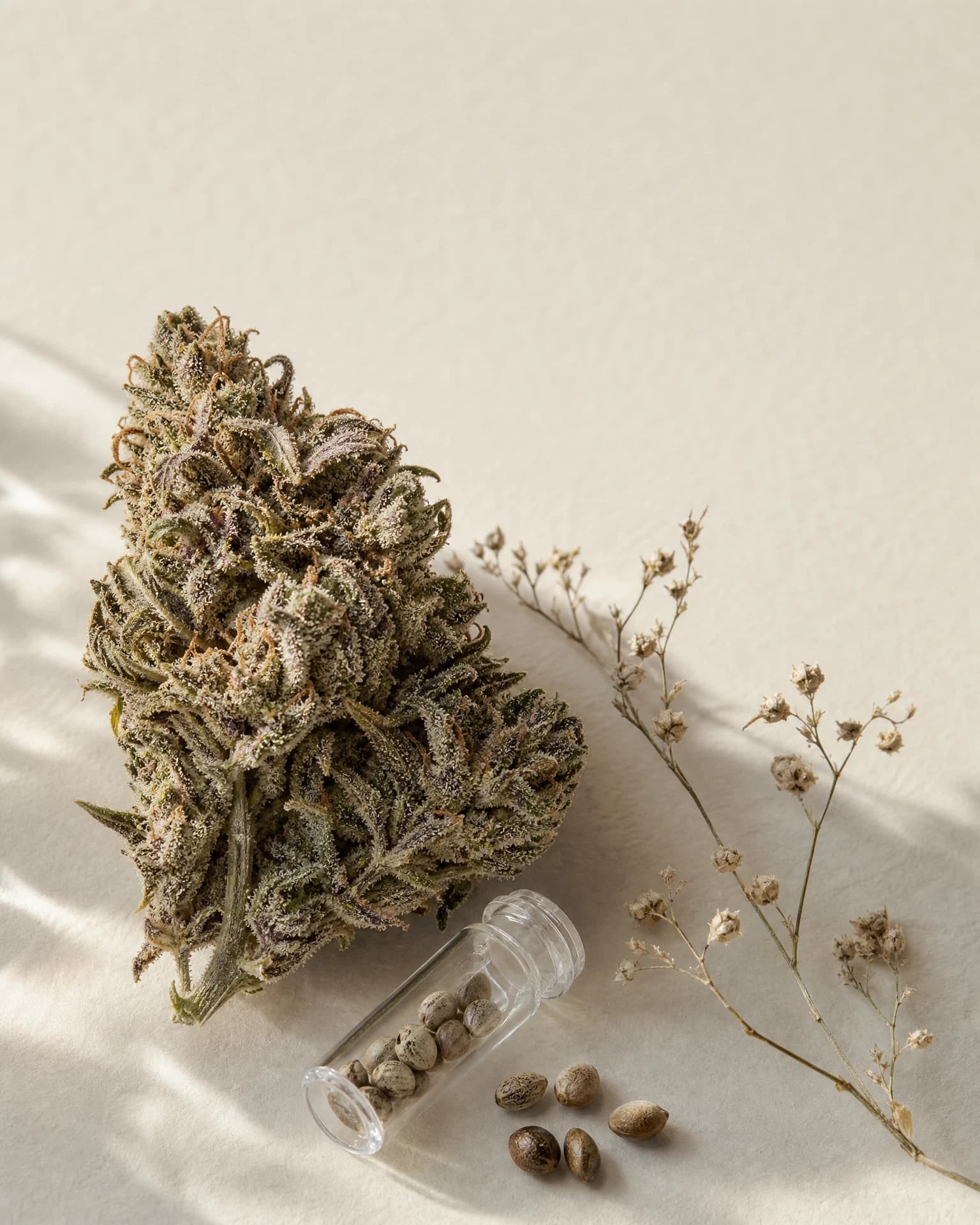
Purple Octane is listed on Seedsupreme’s product page as an indica cultivar associated with The Bulldog, and the public description frames it as carrying gassy and tropical notes with a relaxing character. If you are researching Purple Octane genetics for purchase or planning a grow, this guide helps you interpret what the public product record supplies, what it omits, and how to compare that record with other breeder data and independent documentation. The goal is not to fill gaps with assumptions, but to give you a practical checklist and comparison methods so you can make an informed decision from up-to-date breeder sources and lab documentation.
This overview summarizes what the Seedsupreme listing openly communicates and then maps the missing details to the checks a buyer or grower should perform. Where the public record supplies a concrete label (for example, a seed format), this guide treats that label as a recorded fact. For all other cultivation, chemical, or effect metrics, the guide explains how to verify them from breeder records, lab reports, and community-sourced documentation.
Genetics and cultivar background
What the public record states
- The Seedsupreme product entry for Purple Octane identifies it as an indica and attributes it to The Bulldog. These two items—the reported breeder name and the indica classification—are explicit labels on the public product record.
What the public record does not establish
- The product page does not provide a documented lineage (parent strains or cross), nor does it present breeding notes, generation (F1, F2, stabilized line), or any breeder-issued pedigree documentation. The public record also does not include genetic testing results that would verify ancestry or confirm taxonomic assertions.
How to compare breeder records for genetics
- Check the breeder’s primary source
- Locate The Bulldog’s official channels (official website, breeder catalogue, or verified social accounts). Breeders who provide stable pedigree information will usually publish lineage, the purpose of the cross, and whether the cultivar is a selected phenotype or an F1 hybrid. If The Bulldog lists a pedigree, compare the names and generations with the Seedsupreme product label.
- Look for documented breeding notes
- Breeding notes clarify whether a cultivar is the result of a single cross, backcross, or multi-way deliberate selection. Seek PDF catalogs, breeder blog posts, or press announcements where the cross and selection process are described.
- Search for independent verification
- Third-party genetic lab reports or peer-shared DNA test results (where available) can corroborate asserted parentage. When such tests are cited, examine the testing lab, sample provenance, and whether the result is linked to a treated sample from the named breeder or retailer.
- Use archiving and cross-listing as context
- If multiple reputable seed banks list the same cultivar and attribute the same lineage, that increases confidence in the pedigree claim. Track listing dates and source copies with web archives (see the final section on comparing breeder records for practical steps).
- Pay attention to terminology
- Terms like “indica-dominant,” “pure indica,” or simply “indica” are used variably in marketing. If the breeder relies on morphological or chemotype-based classification, confirm whether they define their terms. Where a breeder’s definition is absent, treat these labels as descriptive rather than genetic certainties.
Questions to ask the breeder or retailer
- Is there a documented pedigree, and can it be shared?
- Was the variety stabilized, and if so, how many generations of selection were performed?
- Are there any breeding or phenotype notes available for review?
When pedigree information is absent from all public records, the cultivator should plan with uncertainty: prepare for a range of growth patterns and phenotypes rather than a single expectation.
Plant profile and grow planning
What the public record states
- The Seedsupreme listing identifies Purple Octane as an indica and lists seed format options (see the Seed formats section). The product entry does not provide additional cultivation metrics such as flowering time, expected height, stretch, or yield estimates.
Designing a grow plan when cultivar-specific details are missing When a seller’s public record omits specific cultivation metrics, use a conservative, flexible planning approach and a targeted comparison routine to reduce risk.
- Prepare for variability
- Without breeder-provided flowering time or height, expect a potential range of photoperiod responsiveness and plant architecture. Allow for more vertical space than a minimal estimate and structure training nets and trellis systems so they can be adjusted.
- Build an adaptable light schedule and environment
- If the cultivar is a photoperiod variety (not specified in the public record), you will control flowering by switching light cycles. Confirm with the breeder whether Purple Octane is photoperiod or autoflowering. If that confirmation is not available, assume photoperiod for planning and include a short verification run (one or two plants) before scaling.
- Design irrigation and nutrition for general responsiveness
- In absence of strain-specific nutrient maps, plan a moderate feeding schedule with careful observation. Monitor runoff EC/pH and adjust incrementally. Keep a phenotype journal to document each plant’s vigor and nutrient sensitivity in case you need to adapt nutrition to specific phenotypes later.
- Training and canopy considerations
- Indica-classified cultivars often show bushier growth with wider leaflets than sativa types; however, individual cultivars may deviate. Use low-stress training (LST) and selective topping conservatively until you observe internode spacing and branch strength. Use stakes or a trellis to support dense bud development if heavy flowering occurs.
- Quarantine and pheno selection
- If you plan to preserve a phenotype, run a small pheno hunt: germinate several seeds, observe vegetative traits, and select the individual(s) that match your goals. This is especially important when breeder documentation on phenotype uniformity is lacking.
Checks to request from the seller or breeder for planning
- Is Purple Octane photoperiod or autoflowering?
- Typical indoor and outdoor flowering windows (if documented).
- Typical mature height as measured by the breeder or in documented trials.
- Any specific nutrient or training recommendations from the breeder.
How to interpret absence of data
- When a breeder or retailer omits critical cultivation metrics, it can mean the cultivar is newer, less documented, or that the seller prefers general marketing language. Use the absence itself as a prompt to ask direct questions and to plan conservatively until you have observed one complete growth cycle with your chosen phenotypes.
Aroma and flavor profile
What the public record states
- The public description supplied with the product listing associates Purple Octane with “gassy” notes and a “tropical” twist. That pairing is part of the product text accessible on the Seedsupreme record.
What the product record does not provide
- The listing does not include an objective terpene profile, laboratory aroma compound breakdown, or a reproducible sensory-test protocol. It also does not provide independent sensory panels, tasting notes with provenance, or the terpene concentration figures that would quantify those descriptors.
How to evaluate aroma and flavor claims
- Use source labels as directional descriptors
- Retail descriptions often use concise sensory shorthand (e.g., “gassy,” “tropical”) to convey a general aromatic family. Treat these as starting points, not guarantees. They signal the breeder or seller’s expectation of dominant impressions but do not replace chemical analysis.
- Look for lab-tested terpene panels
- A terpene chromatogram from a certified lab is the most reliable public indicator of aromatic composition. If a breeder provides a terpene profile, note which terpenes are dominant (for example, limonene, myrcene, caryophyllene) and the testing date. Compare the lab and the sample provenance to ensure the test corresponds to the cultivar batch you’re evaluating.
- Check breeder-supplied sensory methodology
- When a seller claims specific flavors, see whether they document how those flavors were assessed (e.g., number of samples, drying and curing protocol, sample age). Aroma changes substantially with curing time and storage.
- Cross-reference community consensus carefully
- Grower and user forums often share tasting notes. These can be useful for pattern recognition but vary by phenotype and batch. Look for recurring descriptors across multiple independent sources rather than isolated comments.
- Consider terpene variability across phenotypes
- Even within a named cultivar, terpene expression can differ between phenotypes and growing conditions. If consistent buyer-descriptors are critical to your goal, ask the breeder about phenotype uniformity and whether certain phenos produce the “gassy” or “tropical” expression more reliably.
Practical in-grow checks
- During flowering and after small cured samples are available, document aromas at discrete points: late flower, post-dry, 1-week cure, 2-week cure. If you are selecting phenotypes, track which plants reproduce the targeted aroma-family traits.
Reported experience context
What the public record states
- The Seedsupreme product description frames Purple Octane in terms of aromatic and character descriptors. The listing does not provide quantified effect profiling, medical claims, or clinical data.
Why context matters
- Sensory descriptors and effect language on product listings are often shorthand for complex chemotype-and-phenotype relationships. Because labels may conflate seller observation with personal impression, context—such as lab chemistry, breeder notes, and broad user-sourced datasets—matters for interpreting those claims.
How to situate reported experiences
- Distinguish source types
- Separate breeder or retailer language (marketing or product descriptions) from third-party reviews and clinical or chemical data. Breeder statements are primary-source claims about intent; lab reports are primary-source measurements; community reports are anecdotal and phenotype-dependent.
- Look for corroborating chemistry
- If a listing claims a specific character (e.g., "gassy"), search for terpene reports that would typically produce that character (e.g., high levels of terpenes like myrcene, limonene, or caryophyllene, depending on the aromatic family described). Absence of such data means the claim remains unverified.
- Evaluate the scale and provenance of experience reports
- A large number of independent anecdotal reports describing consistent attributes may be useful but also consider sample bias and batch differences. Check whether reports reference the same seed lot, breeder batch, or a wide range of sources.
- Avoid prescriptive or medical inference
- Because the breeder record does not supply medical claims or measured cannabinoid figures, avoid interpreting experiential language as medical benefit. Use experiential reports only for sensory and horticultural pattern recognition, not as health guidance.
How to collect usable experience data yourself
- If the cultivar profile is critical to your decision, plan a controlled small-scale test: germinate multiple seeds, maintain identical environmental conditions, document plant morphology and chemotype (send one cured sample to a lab if possible), and collect sensory impressions systematically.
How to compare current breeder records
Step-by-step comparison workflow
- Assemble primary sources
- Collect the product page(s), the breeder’s official listing, and any lab certificates or breeder-supplied PDFs. Save copies or archive links for each resource.
- Verify publication dates and versioning
- Note the dates on product pages, lab tests, and breeder statements. Breeders sometimes update descriptions or correct pedigree claims; earlier versions can be relevant when tracing a cultivar’s history.
- Compare core fields
- Check for consistency in these fields across sources:
- Cultivar name spelling and synonyms
- Declared breeder or origin
- Seed format(s) (feminized, regular, auto)
- Any declared genetic lineage
- Laboratory test results and lab name/date
- Flowering time and height metrics (if provided)
- Check for consistency in these fields across sources:
- Evaluate laboratory documentation
- For any lab report, confirm:
- The testing laboratory’s accreditation and credibility
- The sample identity and provenance (batch ID, harvest date)
- The date of testing relative to the sample’s harvest and publication
- The cannabinoid and terpene panels and whether they correspond to expected cultivar traits
- For any lab report, confirm:
- Cross-check independent listings
- If multiple reputable seed banks list the cultivar, compare their descriptions. Repeated features (same breeder attribution, same basic aroma descriptors, same seed formats) increase confidence in those attributes. Divergences warrant direct queries to the breeder.
- Use archival tools and community records
- If information has changed or been removed, the Wayback Machine and archived catalogs can reveal earlier claims or pedigree notes. Community resources—grow logs, controlled pheno hunts, and long-form forum threads—can fill practical gaps but should be corroborated with provenance info.
- Contact the breeder with targeted questions
- Ask succinct, specific questions: provide the batch or catalog reference and request clarification on unanswered points (pedigree, photoperiod status, typical flowering window, lab tests for a specific batch). Document their responses.
- Weight the evidence
- Treat hard documentation (official breeder statements, lab reports tied to a batch, and pedigree documents) as stronger evidence than unsourced community impressions or retail marketing text.
Red flags and clarifying probes
- No lab documentation when the cultivar is marketed on sensory or effect grounds: ask why and whether any testing has been performed.
- Conflicting pedigree across different sellers: request clarification from the breeder; ambiguous lineage can be a sign of rebranding or derivative crosses.
- No breeder contact or evasive responses: a reputable breeder typically provides at least some background or is transparent about new or experimental lines.
Recording and version control
- Keep a comparison matrix (simple spreadsheet) listing each source, the date copied, and the exact claims for those core fields. Update the matrix when you receive direct breeder replies or new lab reports so you can trace how the public record evolved.
Wrapping up: managing uncertainty and using the record sensibly Purple Octane’s public product record on Seedsupreme supplies three concrete pieces of information you can rely on from the listing itself: the cultivar name, an indica classification, and the offered seed format (feminized). For all other attributes—lineage, chemistry, flowering, yields, and detailed effects—you should seek out breeder documentation, lab reports tied to specific batches, and corroborating listings. Use the comparison workflow above to assemble evidence, document provenance, and form a working plan for cultivation or selection that anticipates phenotype variability.
Where the public record is silent, adopt conservative planning and targeted verification. That approach reduces surprise and gives you actionable steps—contact the breeder, request lab results or a phenotype sheet, run a small pheno selection, and archive every documented reply—so you can responsibly evaluate Purple Octane genetics and determine whether the cultivar matches your goals.
Frequently asked questions
What is the Purple Octane strain?
This guide summarizes the documented cultivar record while separating verified details from variable grower outcomes.
Is Purple Octane suitable for beginners?
Difficulty depends on the exact seed line, environment, and grow setup. Confirm current breeder guidance.
How long does Purple Octane take to flower?
Flowering windows vary by phenotype and environment. Confirm the estimate for the exact breeder line.
Can Purple Octane be grown indoors and outdoors?
Suitability depends on the breeder line and local climate. Compare space, humidity, temperature, and season length.
Which Purple Octane seed format should I choose?
Autoflower and feminized formats serve different schedules and grow styles. Compare only documented direct records.