
Strain guide
White Widow Feminized Strain Guide: Breeder-specific aroma and grower notes
White Widow Feminized is documented here with partner-source cultivar context, seed-format availability, and secondary-topic research cues.
Overview
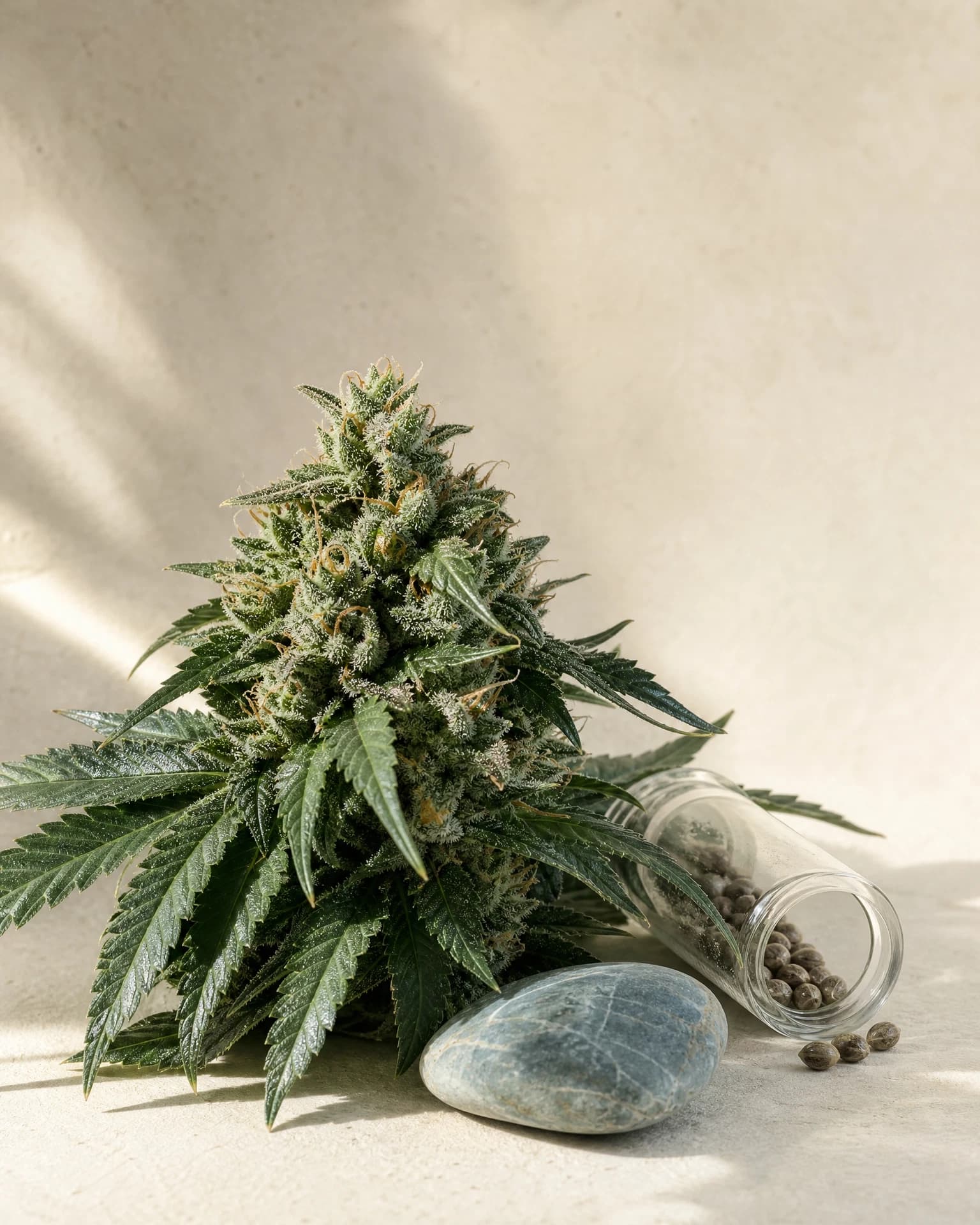
The White Widow feminized strain is identified in botanical records as a balanced hybrid cultivar. This classification indicates that the plant possesses a genetic lineage that draws from both Sativa and Indica backgrounds, aiming for a middle ground in its structural and chemical expression. According to the primary data, this specific cultivar is the result of a cross between a Brazilian Landrace Sativa and a South Indian Indica. The physical manifestation of this genetic combination typically results in a plant that maintains a stocky and bushy structure. One of the most distinctive features noted in the verified facts is the presence of dense buds that are heavily coated in white resinous trichomes, a characteristic that often defines the visual identity of this cultivar in professional catalogs.
The development cycle for this cultivar follows a predictable timeline for photoperiod plants, with a white widow feminized flowering time generally spanning between 8 and 10 weeks. This window allows for the maturation of the resin-heavy flowers, though the exact timing may vary depending on the specific environmental conditions and the particular breeder source being referenced. As a balanced hybrid, the cultivar sits within a range of genetic ratios, with reports indicating a split that can vary from 45/55 to 60/40 between Indica and Sativa dominance. This variance highlights the importance of checking individual retailer data, as the specific expression of the lineage can shift based on the selection process used by different seed producers.
Availability for this cultivar is primarily concentrated in the form of White Widow Feminized genetics. These are photoperiod-dependent seeds that have been treated to ensure a high probability of producing female plants, which are the ones responsible for the resinous flower production described in the technical profiles. The record indicates that while the cultivar is widely available, the chemical potency, specifically the THC content, shows a significant range across different commercial listings. Some sources report levels as low as 18%, while others claim concentrations reaching as high as 30%. This broad range emphasizes the variability inherent in modern cannabis breeding and the necessity for thorough research when selecting a specific source for this cultivar.
Genetics and cultivar background
Understanding the genetics of the White Widow feminized strain requires an examination of its landrace heritage. A landrace refers to a cultivar that has developed over a long period in a specific geographic region, adapting to the local climate and environment without significant human intervention or cross-breeding with outside varieties. In this case, the lineage is rooted in two distinct geographic areas: Brazil and South India. The Brazilian parent is classified as a Landrace Sativa, while the South Indian parent is an Indica variety. The combination of these two diverse genetic pools is what creates the balanced hybrid profile that is the hallmark of this cultivar.
The concept of a balanced hybrid is fundamental to modern cannabis taxonomy. In a botanical context, a hybrid is the offspring of two plants of different varieties or species. When a breeder crosses a Sativa-dominant landrace from South America with an Indica-dominant variety from the Indian subcontinent, the goal is often to stabilize certain traits from both parents. For this cultivar, the resulting genetic ratio is not fixed; the caveat in the record notes that the Indica/Sativa balance can range from 45/55 to 60/40. This means that some versions of the plant may lean slightly more toward the structural characteristics of the Indica parent, while others might show more of the growth patterns associated with the Sativa parent.
The use of landrace genetics is often sought after in breeding programs because these plants are considered to have "pure" genetic traits that have not been diluted by modern hybridization. By crossing a Brazilian Sativa with a South Indian Indica, the original breeders of this cultivar created a foundation that has been used in countless subsequent crosses. However, the record for this specific version focuses strictly on the primary cross. It does not provide details on the specific individuals or the history of the breeding process, emphasizing instead the resulting botanical characteristics and the wide variance in reported chemical profiles. This focus on the fundamental genetic building blocks provides a clear starting point for anyone researching the origins of this balanced hybrid.
When evaluating the background of such a cultivar, it is useful to consider the role of geographic isolation in the development of landrace traits. Brazilian Sativas are often associated with environments that provide long growing seasons and high humidity, while South Indian Indicas may come from regions with different climatic pressures. The merging of these two distinct evolutionary paths into a single cultivar represents a significant event in the history of cannabis breeding, even if the specific details of that event are not contained within this particular record. The resulting plant is a testament to the diversity of the species and the ways in which human selection can combine disparate traits into a stable, recognizable form.
Plant profile and grow planning
The physical profile of this cultivar is described as typically exhibiting a stocky and bushy plant structure. In practical terms, a stocky structure suggests a plant that does not reach extreme heights but instead focuses its energy on lateral growth and the development of a strong central stem. A bushy habit indicates a high degree of branching, which can lead to a dense canopy of foliage. This structural information is vital for planning the cultivation space, as it suggests that the plant will require sufficient horizontal room to accommodate its spread. The record notes that for more specific details on height or width, one should check the current breeder source, as these traits can be influenced by specific selection and environmental factors.
Flowering time is a critical component of any grow plan, and for this cultivar, the white widow feminized flowering time is listed as 8 to 10 weeks. This period refers to the time from the initiation of the flowering stage—usually triggered by a change in the light cycle for photoperiod plants—to the point where the buds have reached full maturity. A 10-week flowering window is relatively standard for a balanced hybrid, providing enough time for the development of the dense buds and the heavy coating of white resinous trichomes that are characteristic of this cultivar. Planning for this duration involves ensuring that the environment remains stable throughout the entire two-month-plus period to avoid stressing the plant during its most critical phase of production.
The presence of dense buds and heavy resin production has implications for the final stages of the growth cycle. Dense floral structures can be more susceptible to environmental issues such as high humidity, which can lead to moisture being trapped within the buds. The heavy coating of trichomes, which gives the plant its name and distinctive appearance, is the primary site of cannabinoid and terpene production. While the record does not specify the exact yield or the specific environmental requirements like temperature or nutrient levels, the description of the plant as "stocky and bushy" provides a clear indication of its general growth habit. This information allows a researcher to infer the need for techniques that manage a dense canopy, such as pruning or training, although the record itself does not mandate these practices.
When planning for this cultivar, it is also important to account for the variance in the Indica/Sativa ratio. A plant that leans 60% toward Indica may have broader leaves and a more compact structure than one that is 55% Sativa. Since the record indicates this ratio can vary between 45/55 and 60/40, a grower must be prepared for some degree of phenotypic variation. This means that two different seeds from the same cultivar name, but from different breeder sources, might show slightly different growth patterns. The recommendation to check the specific breeder source for structural details is a reminder that while the general characteristics are stable, the fine details are subject to the specific genetic selection made by the producer.
Aroma and flavor profile
The current record for the White Widow feminized strain does not provide specific details regarding the aromatic compounds or the flavor profile of the flowers. In the absence of this data, it is important to understand the general role of terpenes in the cannabis plant and how they contribute to the sensory experience. Terpenes are organic compounds produced in the same resinous trichomes that are so prominently featured in the description of this cultivar. While we know the buds are "heavily coated in white resinous trichomes," the specific chemical makeup of that resin—which would dictate the scent and taste—is not listed in the verified facts.
In a general educational context, the aroma of a cannabis cultivar is usually the result of a complex interaction between various terpenes such as myrcene, limonene, caryophyllene, and pinene. Each of these compounds contributes a different note, ranging from earthy and musky to citrusy or spicy. Because this cultivar is a cross between a Brazilian Sativa and a South Indian Indica, it likely possesses a terpene profile that reflects its diverse heritage. However, without specific data, any claim about a particular scent—such as "earthy" or "woody"—would be speculative and not supported by the evidence provided in this record.
Similarly, the flavor profile is an extension of the aromatic compounds, often influenced by the way the plant is grown, harvested, and cured. The record's silence on this topic means that a researcher must look to individual breeder descriptions to find what specific flavor notes they have selected for in their version of the cultivar. The lack of information in a centralized record like this one often points to the high degree of variation that can exist between different commercial versions of the same strain name. What one breeder describes as a "spicy" flavor, another might characterize differently, depending on the specific phenotypes they have stabilized.
When a record states that specific profile details should be checked at the source, it highlights a common challenge in the cannabis industry: the lack of standardized chemical reporting. While THC levels are often tested and reported—showing a range of 18% to 30% for this cultivar—terpene profiles are less frequently included in basic strain guides. For a researcher, this means that the sensory characteristics of the White Widow feminized strain remain a variable that must be confirmed through the specific documentation provided by the seed bank or retailer at the time of purchase. Stating that these fields are unknown is a more accurate reflection of the available evidence than relying on generalized descriptions found in other, less rigorous sources.
Reported experience context
The experience associated with a particular cannabis cultivar is a subjective area that is often influenced by the chemical profile of the plant and the individual physiology of the user. In the case of the White Widow feminized strain, the record does not list specific effects, medical uses, or reported experiences. Instead, it provides data on the primary chemical driver of the experience: the THC content. The reported THC levels for this cultivar show a wide variance, ranging from 18% to 30% across different retailers. This range is significant, as a plant with 18% THC will interact with the human endocannabinoid system differently than one with 30% THC.
The absence of specific reported effects in the record is an important distinction to maintain. Many guides rely on anecdotal evidence to describe a cultivar as "uplifting" or "relaxing," but such claims are not part of the verified facts for this record. Instead, the focus is on the botanical and chemical data. The balanced hybrid nature of the plant, with its 45/55 to 60/40 Indica/Sativa ratio, suggests that the experience may incorporate elements from both sides of the cannabis spectrum. However, the exact nature of that balance is not defined. The wide range in the Indica/Sativa ratio further complicates any attempt to generalize the experience, as a more Sativa-leaning phenotype may produce a different result than an Indica-leaning one.
When evaluating the potential experience of a cultivar without specific effect data, researchers often look at the concentration of cannabinoids. The high end of the reported THC range (30%) places this cultivar among the more potent options available on the market. Potency is a measure of the concentration of active compounds, and a higher concentration generally leads to a more intense experience. The variance mentioned in the caveat—18% to 30%—is a reminder that the name of a cultivar is not a guarantee of a specific potency level. Factors such as the breeder's selection, the growing conditions, and the post-harvest processing all play a role in determining the final chemical composition of the flower.
For those looking to understand the context of the reported experience, it is also useful to consider the role of the "entourage effect," a theory suggesting that cannabinoids and terpenes work together to produce a specific outcome. Since the terpene profile for this cultivar is not listed, the full context of how the 18-30% THC might be modulated by other compounds is unknown. In a professional research setting, the lack of this information would lead to a recommendation for lab testing of specific batches rather than relying on generalized strain descriptions. By stating that the effects are unknown and focusing on the verified chemical variance, this guide provides a more grounded and evidence-based perspective on what a user might expect.
How to compare current breeder records
Comparing breeder records for a cultivar like the White Widow feminized strain requires a methodical approach to identifying both consistencies and discrepancies in the data. The primary challenge, as highlighted by the caveat in this record, is the significant variance in reported chemical and genetic profiles. When one retailer reports a THC level of 18% and another reports 30%, it is not necessarily a case of one being "wrong." Instead, it often reflects the different genetic selections (phenotypes) that each breeder has chosen to stabilize and market under the same cultivar name. A researcher must learn to look past the name and examine the specific technical data provided by each source.
The first step in comparing records is to look at the genetic lineage. In this case, the record is consistent: a cross between a Brazilian Landrace Sativa and a South Indian Indica. If a breeder listing claims a different lineage for a plant called "White Widow," it is a clear sign that they are offering a different genetic product. The second point of comparison is the flowering time. The 8 to 10-week window provided in this record is a standard benchmark. If a source claims a much shorter or longer period, it may indicate a variation in the genetics or a different set of environmental assumptions. A researcher should also look for descriptions of the plant structure; the "stocky and bushy" description here should be reflected in the breeder's own growth notes.
The caveat regarding the Indica/Sativa ratio—ranging from 45/55 to 60/40—is a perfect example of why source comparison is necessary. These numbers represent the breeder's assessment of how the plant grows and the type of experience it might provide. A 60% Indica-dominant version may be preferred by someone with limited vertical space, while a 55% Sativa-leaning version might be chosen for different reasons. By checking multiple retailers, a researcher can see which version of the "balanced hybrid" best fits their specific needs. This process involves looking at the technical specifications, reading the breeder's own description of their selection process, and verifying the lab results if they are provided.
Finally, a responsible researcher must account for the missing data in a record. As noted in this guide, specific terpene profiles, yield numbers, and detailed effects are not part of the verified facts. When a breeder provides this information, it should be treated as specific to their version of the cultivar. Comparing these additional details across different sources can reveal the unique "personality" that each breeder has tried to cultivate. However, one must always return to the foundational facts—the lineage, the flowering time, and the general structure—to ensure that the plant being considered is indeed a representative of the White Widow feminized strain. The ability to distinguish between stable genetic traits and breeder-specific variations is the mark of a sophisticated researcher in the modern cannabis market.
The information provided in this guide is strictly bounded by the record for the White Widow feminized strain. This record serves as a centralized summary of verified facts, but it also carries significant caveats that must be understood to interpret the data correctly. The most important caveat is the variability in the reported chemical and genetic profiles. As stated in the record, THC levels are not fixed and can range from 18% to 30% depending on the source. Similarly, the Indica/Sativa ratio is not a single number but a range between 45/55 and 60/40. These ranges are not errors; they are reflections of the diversity within the cultivar as it is produced and sold by various retailers.
The verified facts in this record are derived from a cross-section of data from multiple commercial sources. While these sources agree on the fundamental lineage—a cross between a Brazilian Landrace Sativa and a South Indian Indica—they may differ on the finer points of the plant's expression. The description of the plant as having a "stocky and bushy structure" with "dense buds heavily coated in white resinous trichomes" is a consensus view, but specific measurements for height, width, and yield are not included because they vary too much between sources to be considered "verified facts" in a general sense.
One should also observe what is missing from this record. There is no information regarding the specific aroma, flavor, or effects of the cultivar. In a professional botanical or horticultural context, the absence of a fact is just as important as its presence. It indicates that the data is either not standardized, not consistently reported, or not available in a way that meets the criteria for inclusion in this specific guide. A researcher should not infer these missing details from the name of the cultivar or from other unverified sources. Instead, the recommendation is to consult the specific breeder source for the most current and detailed information regarding their particular version of the White Widow feminized strain.
Finally, the 8 to 10-week white widow feminized flowering time and the availability of feminized photoperiod seeds are the most stable technical details provided. These facts provide a reliable framework for understanding the plant's life cycle and its availability in the market. However, even these details should be verified against the specific instructions provided by the seed producer at the time of purchase. By adhering to the evidence presented in this record and acknowledging the inherent limits of the data, this guide provides a responsible and accurate foundation for researching one of the most well-known balanced hybrids in the cannabis world.
Given the specific constraints and missing data in the current record for the White Widow feminized strain, several questions remain for a researcher to explore. These questions are designed to fill the gaps in the verified facts and provide a more comprehensive understanding of the cultivar through further investigation of primary breeder sources and laboratory data. By identifying what is not known, a researcher can focus their efforts on finding high-quality, source-specific information rather than relying on generalized assumptions.
One of the most immediate areas for further research is the specific terpene profile of the cultivar. Since the record notes that the buds are "heavily coated in white resinous trichomes" but does not list the chemical constituents of that resin, a researcher might ask: What are the primary and secondary terpenes found in the most common phenotypes of this strain? Does the terpene profile shift significantly between the 45/55 and 60/40 Indica/Sativa ratios? Finding lab results for specific batches from different retailers would be the only way to answer these questions with any degree of accuracy. This information would also provide the missing context for the aroma and flavor of the cultivar.
Another area of interest is the specific environmental preferences of the plant. The record mentions a "stocky and bushy" structure but advises checking the breeder source for more details. A researcher could investigate: What are the optimal temperature and humidity ranges for maximizing resin production in this cultivar? Does the Brazilian Sativa heritage make it more resistant to certain types of environmental stress, or does the South Indian Indica background dictate a need for specific nutrient levels? Understanding these nuances would be essential for anyone planning to cultivate the plant, as the 8 to 10-week flowering time is a significant investment that requires optimal conditions for success.
The wide range of reported THC levels (18% to 30%) also raises important questions about genetic stability and testing methods. A researcher might ask: What factors contribute to such a large variance in reported potency for the same cultivar name? Are these differences due to the specific genetic selections made by different breeders, or do they reflect differences in how the plants were grown and tested? Furthermore, are there other cannabinoids, such as CBD or CBG, present in meaningful amounts that were not included in the primary record? By pursuing these questions, a researcher can move beyond the basic facts and develop a more nuanced understanding of the White Widow feminized strain as it exists in the current commercial market.
Frequently asked questions
What is the White Widow Feminized strain?
This guide summarizes the documented cultivar record while separating verified details from variable grower outcomes.
Is White Widow Feminized suitable for beginners?
Difficulty depends on the exact seed line, environment, and grow setup. Confirm current breeder guidance.
How long does White Widow Feminized take to flower?
Flowering windows vary by phenotype and environment. Confirm the estimate for the exact breeder line.
Can White Widow Feminized be grown indoors and outdoors?
Suitability depends on the breeder line and local climate. Compare space, humidity, temperature, and season length.
Which White Widow Feminized seed format should I choose?
Autoflower and feminized formats serve different schedules and grow styles. Compare only documented direct records.